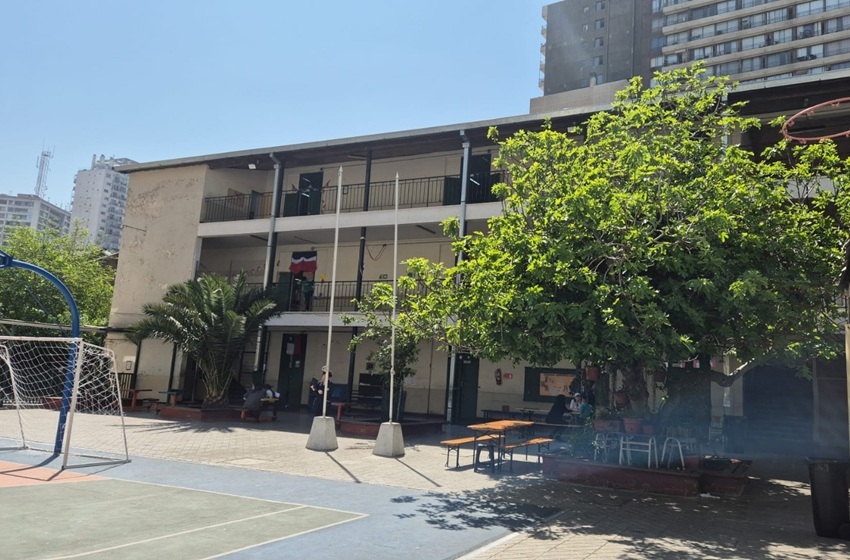
The pioneering REDES+ initiative, led by researchers from the Hémera Center and the School of Forest Engineering at Universidad Mayor, aims to collect local data and provide easy access to environmental information for educational communities.
Exposure to air pollution has become a growing global concern, particularly due to its significant impact on human health. Children are especially vulnerable, experiencing a range of short- and long-term effects, including acute and chronic respiratory diseases, as well as impacts on neurological development that may lead to cognitive alterations and affect academic performance.
In this context, around 50 public schools in the Metropolitan Region will participate in the initiative “REDES+: School Network for Environmental Monitoring in Santiago”, a project that seeks to implement a network of air quality and temperature sensors across the 34 municipalities of Greater Santiago.
The initiative is driven by an interdisciplinary team of researchers from the Hémera Center and the School of Forest Engineering at Universidad Mayor, together with the C+ Research Center of the Faculty of Engineering at Universidad del Desarrollo (UDD), the Center for Epidemiology and Health Policy at UDD, and the Department of Sciences at Universidad Adolfo Ibáñez.
“REDES+ is a pioneering interdisciplinary research project in Chile that studies how air pollution, extreme temperatures, and vegetation in the school environment influence attendance and academic performance among elementary school students in Greater Santiago,” explained Claudia Montoya, faculty member at the School of Forest Engineering, Universidad Mayor.
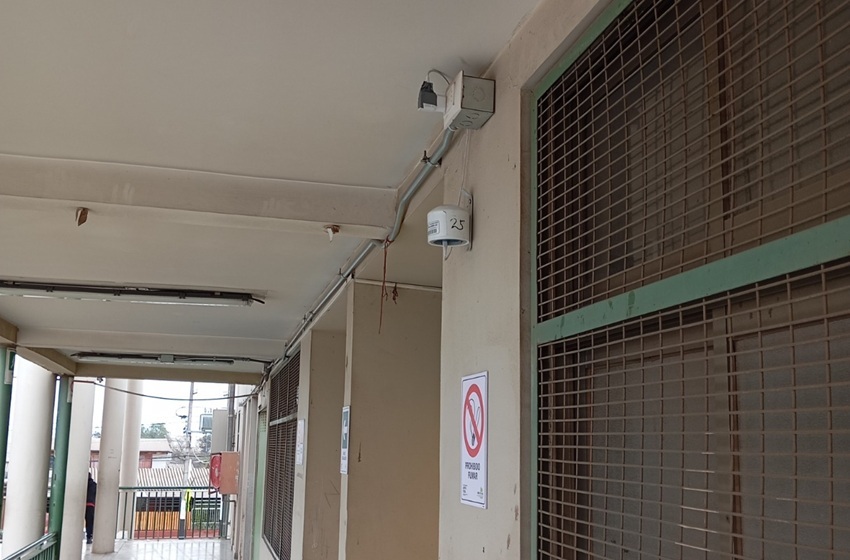
Currently, the sensors are measuring fine particulate matter (PM2.5) and temperature in real time—key environmental variables that influence the school environment and student attendance—making all information available through a web platform for students, parents, and the local communities surrounding educational institutions. This supports decision-making aimed at improving environmental quality and school well-being.
Impacts of Wildfires
The sensors have made it possible to identify acute events and quantify concentrations of particulate matter in the environment, such as nighttime smoke associated with recent wildfires.
The data also reveal differences in exposure between neighborhoods, showing spatial variability that often remains hidden at the city scale. The information generated will help improve understanding of how these geographic variations may interact with school environments and with children’s learning.
“This initiative allows us to capture acute pollution episodes associated with wildfires that are often not reflected in regulatory averages. This is key to understanding real exposures in school environments, especially during short-duration smoke events that can have significant impacts on children’s health and learning,” said Blanca Ríos, researcher at the Hémera Center.
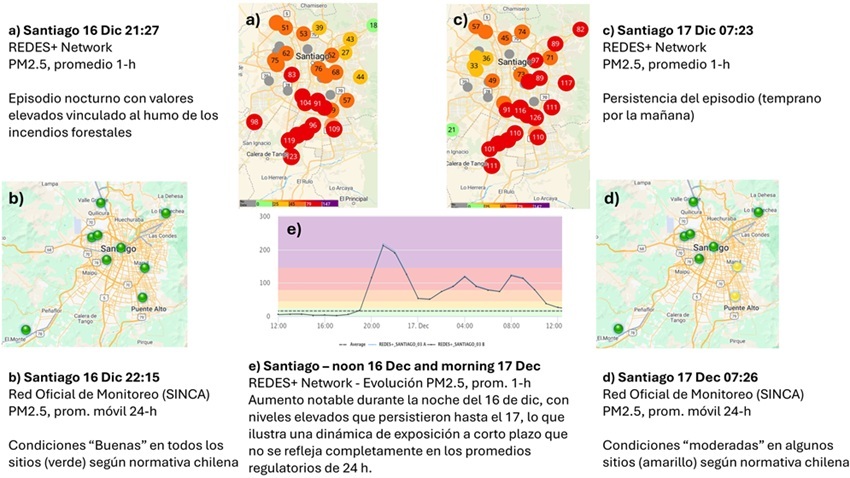
(PM2.5 episode associated with wildfire smoke in Santiago on December 16 and 17, observed by the REDES+ network with hourly resolution (top panels) and by the official SINCA network using 24-hour moving averages (bottom panels). The comparison shows marked spatial differences and highlights short-duration episodes that are not fully reflected in regulated metrics.)